


Track 7 The Axe of the Bruce (1.15 of 3.34)
Fought on June 23-24, 1314, the Battle of Bannockburn was a decisive clash in the First War of Scottish Independence. King Robert the Bruce of Scotland decisively defeated a larger English army led by King Edward II, securing Scottish sovereignty and confirming Bruce's throne.
Symbol of Freedom: The Axe of the Bruce became a potent symbol of Scottish defiance and freedom, inspiring countless tales and legends throughout the centuries, and a reminder of the raw power and determination of its wielder.
The CD Booklet Narrative for Track 7
The Axe Of The Bruce
Scotland's Legendary Weapon
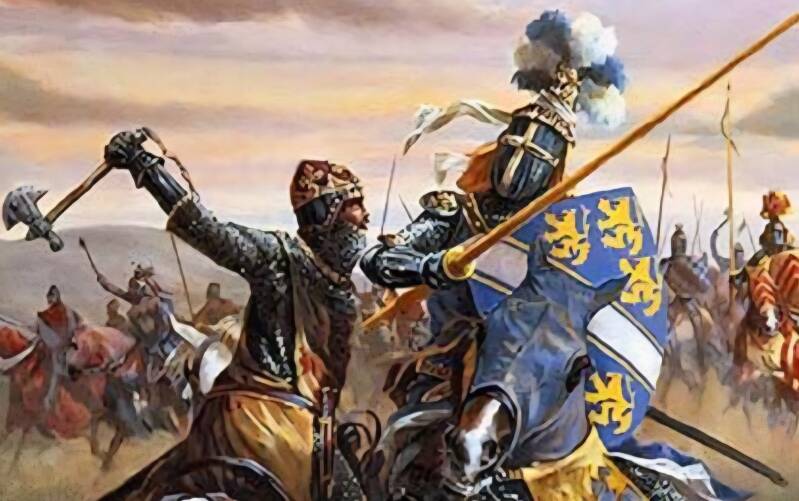
On the eve of the Battle of Bannockburn in 1314, as the Scottish army prepared to face the might of the English, a legend was forged not by a sword, but by an axe. Robert the Bruce, King of Scots, rode before his lines, surveying his men.
As he moved, an English knight, Sir Henry de Bohun, spurred his horse forward, charging directly at the King, lance couched. It was a bold, desperate move to end the battle before it began. Yet, Bruce, though mounted on a small palfrey and armed only with his battle axe, met the challenge head-on. With a swift and powerful blow, he cleaved de Bohun's helmet and skull, splitting him to the chin.
The act was more than a kill; it was a defiant roar, a declaration that Scotland's King would not yield. The axe, a simple tool of war, became imbued with the spirit of a nation fighting for its liberty. It was a weapon of raw power, a symbol of courage and resilience.
This axe, wielded by the Bruce, became an iconic artifact of Scottish history. It represented not just the strength of a king, but the unyielding will of a people. It was a beacon of hope in dark times, a testament to the belief that even against overwhelming odds, freedom could be won.
Today, the legend of the Axe of the Bruce continues to inspire, reminding us of the pivotal moment when a single act of bravery turned the tide of history. Now, listen to the tale of this legendary weapon.
The Battle of Bannockburn was caused by English attempts to claim sovereignty over Scotland and King Robert the Bruce’s demand for the surrender of Stirling Castle, a vital English-held fortress. When King Edward II led a large army north to relieve the siege, it triggered the decisive clash.
English Claim to Power: English monarchs tried to control Scotland since the Wars of Scottish Independence started in 1296.
Robert the Bruce's Campaign: Robert the Bruce reclaimed the Scottish throne and captured most English-held territory by 1314.
The Siege of Stirling Castle: Bruce gave a deadline for the English garrison at Stirling Castle to surrender.
Edward II's Relief March: King Edward II marched an army into Scotland to break the siege and reassert English authority.